The arithmetic of one queen
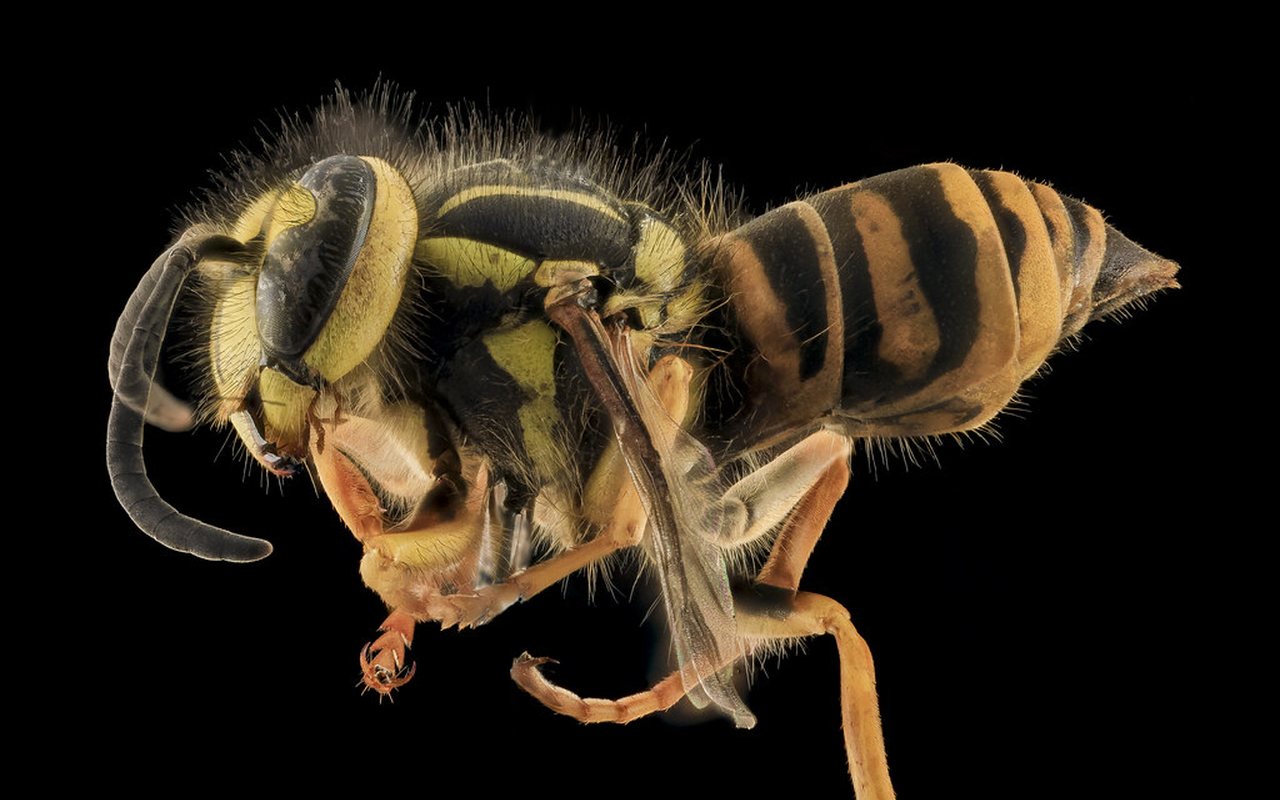
A western yellowjacket colony starts in April with a single overwintered queen and a nest the size of a walnut. Nobody notices. By late June the workers she raised have taken over the building and the hunting, and the colony is a few hundred. By mid-August it can be several thousand insects, and the behavior has changed: the colony stops hunting caterpillars and starts scavenging sugar.
That switch is why the second half of August feels like an ambush. There are not a great many more of them than there were in July. They are simply at your picnic table now.
Ground nests, and how people find them
Western yellowjackets nest underground, most often in an abandoned vole burrow in a lawn, sometimes in a void under a paver, a stump, or behind a piece of siding. There is nothing to see except a steady two-way stream of insects entering and leaving one small hole.
The mower finds it. So does the string trimmer, the pressure washer and the child running across the grass. Vibration is the trigger, and a disturbed ground colony sends out dozens of defenders within a couple of seconds. Most of the sting incidents in Snohomish County every August happen this way.
The single best thing you can do in July is walk the lawn slowly and look for that traffic. A nest found in July is a small nest.
The three species you will see here
Western yellowjackets, in the ground, aggressive, and the ones at the pop can.
Bald-faced hornets, which build the grey paper football hanging from a limb, an eave or a soffit. Large, black and white, and defensive of the nest at a distance of several feet.
Paper wasps, which build the small open umbrella comb under a deck rail, a mailbox or a porch light. Least aggressive, useful predators, and often best left alone if the nest is away from foot traffic.
What to leave alone and what to call about
- Do not spray a ground nest and stand over it. They come out fast and they orient on movement and carbon dioxide.
- Do not plug a wall-void entry. The colony chews inward and emerges inside the house.
- Do not knock a bald-faced hornet nest down from a ladder. The fall hurts more than the stings.
- Do not attempt any of it if anyone on the property has a known sting allergy.
- Call about anything in a wall, a soffit or the ground near a door, walkway or play area.
And the hornet everyone still asks about
Washington confirmed northern giant hornets in Whatcom County between 2019 and 2021, and the state ran a large trapping and eradication effort. In December 2024 the Washington State Department of Agriculture and the USDA announced the species had been eradicated from Washington and the United States, after three straight years with no detections.
So the very large wasp on your deck in Marysville is a bald-faced hornet, a European paper wasp, a queen yellowjacket, or a native cicada killer. WSDA still takes public reports with photographs if you believe you have seen something unusual, and photographs are what make a report useful.
Further reading: WSDA hornet and wasp program.
If you would rather hand this to somebody, see Wasp and Hornet Removal in Marysville, WA or call 360-233-2008.