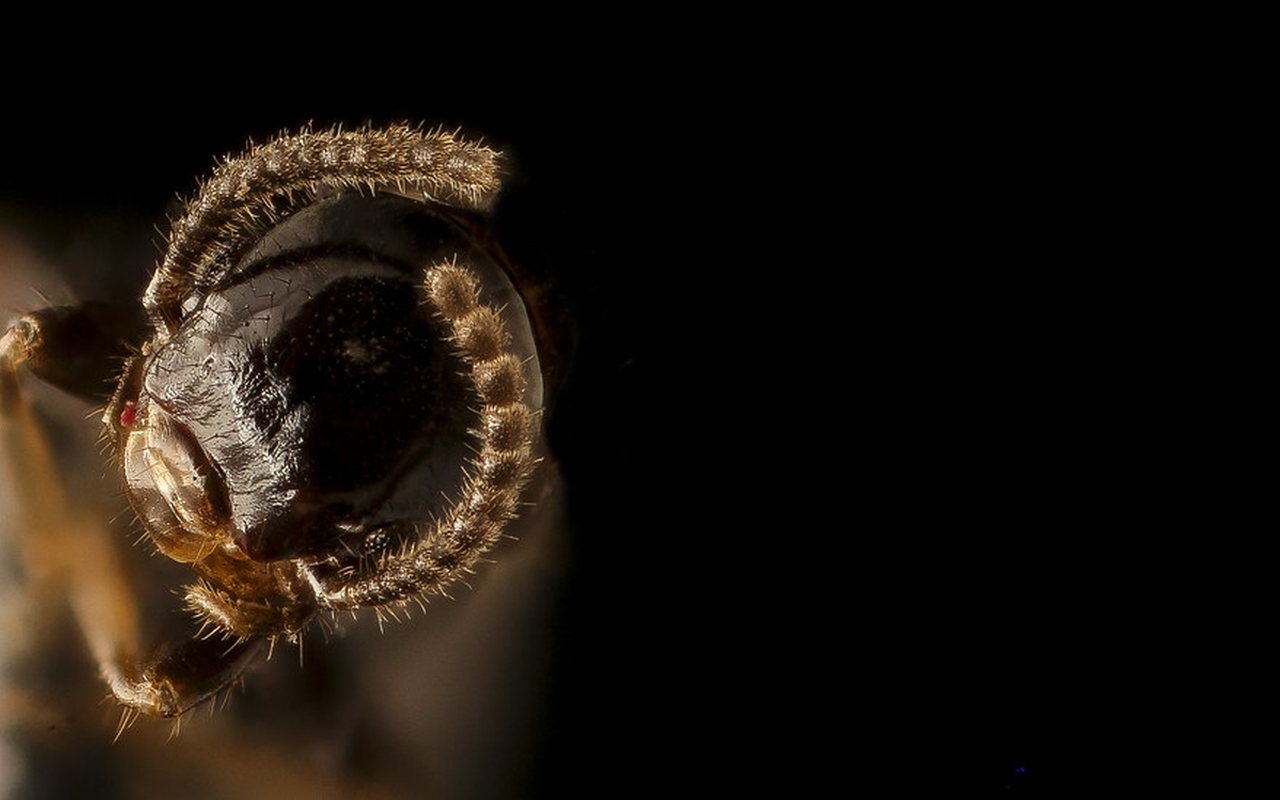
The four tells, in order of reliability
That fourth tell is the one that matters when there is no insect to look at, which is most of the time. If you have pulled a trim board and you are looking at damaged wood, the question is not what bit it, it is what is packed inside it.
- The waist. An ant has a pinched, wasp-like waist. A termite is straight-sided from thorax to abdomen, like a grain of rice.
- The antennae. An ant antenna is elbowed, bent sharply partway along. A termite antenna is straight and beaded.
- The wings. A winged ant has two large front wings and two smaller back wings. A winged termite has four wings of equal length, all longer than its body, and they drop off easily. A pile of identical discarded wings on a windowsill is a termite swarm, not an ant swarm.
- The galleries. Carpenter ant galleries are excavated clean and sanded smooth, because the ants carry the shavings out and dump them as frass. Termite galleries are packed with soil and fecal material and look muddy.
What lives here
The western carpenter ant, Camponotus modoc, is far and away the most common wood-associated insect in Snohomish County homes. Black or black-and-red, up to half an inch, most active at dusk, and drawn to wood that has already been softened by moisture. It does not eat wood. It hollows it out to nest.
The Pacific dampwood termite, Zootermopsis angusticollis, is a genuine western Washington species and a large one. It attacks wood with high moisture content: buried stumps, wet sill plates, fence posts, and framing under a chronic leak. Swarms fly on warm evenings in late summer and early autumn.
The western subterranean termite, Reticulitermes hesperus, is present too, less common, and it builds the shelter tubes of packed soil across foundations that everyone associates with termites in the South.
The practical upshot for a Marysville homeowner: it is probably carpenter ants, but a mud-packed gallery or a pile of equal-length dropped wings means it is not, and the treatment is completely different.
Frass, and what it tells you
Carpenter ant frass looks like coarse pencil shavings with insect body parts mixed in. It piles up under the gallery, which means under a crawl-space vent, a deck ledger, a window sill, a soffit corner. Fresh frass means an active gallery, right now, above where you are standing.
Termites produce no frass of that kind. Dampwood termites push out small hard fecal pellets. Subterranean termites produce mud tubes.
Neither insect is a wait-and-see problem, but they run at different speeds. Carpenter ants hollow a rim joist over several seasons. That is slow enough that a great many Marysville homeowners live with them for years and find out during a sale, when an inspector puts a screwdriver through the sill plate.
What to do about it
Photograph the insect and the damage. Keep a sample in a small container. Then dry the wood out: clear the gutter, extend the downspout, fix the flashing, replace the vapor barrier, pull the mulch six inches off the siding. Moisture is the whole game on the wet side.
Then call. Carpenter ant treatment means finding the parent colony as well as the satellite, and that is a dusk inspection and a crawl space, not a can of spray. If it is termites, the treatment and the structural scope are different again.
Washington State University Extension keeps a free identification and management resource for both, written for this region rather than for the Southeast.
Further reading: WSU Extension Hortsense.
If you would rather hand this to somebody, see Carpenter Ant Treatment in Marysville, WA or call 360-233-2008.